Credit Card Expert Witness

How one chooses to deal with bad news, tells a lot about the integrity of people running the organization.  As a credit card expert witness RK Hammer can assist with the litigation. “Running and hiding” in the hope it will all just go away is never good PR strategy.  

We’ve seen some business owners and politicians try to hide the bad news, delay the updates, to their ruination.  Coming clean with bad news is important and necessary.  To hide from the truth brings out damage to your cause, often greater than the initial crisis itself.  The crisis won’t get you; the lying about it will.  Ask those former politicians who used to be important.  Their example shows us what not to do.

First, face the facts, damaging as they may seem.  Then, ask yourself what is the worst that could possibly happen as a result of the crisis.  Next, probe for corrective measures which could make a repeat of the problem far less possible.  Confide in trusted advisors such as credit card expert witness RK Hammer who may have insight in how to get out in front with responsible damage control.  If someone gives you good – but painful – advice, take it.

Then, be prepared to explain all of the above to the public and what you are doing about it now, and how the problem arose in the first place.  Give them a timetable for new updates, and who in the organization the press and others may contact for news on the matter going forward.  There is no magic bullet for dealing with very bad news, except to look at recent history as to how not to do so.  Get out in front of bad news quickly, before the press comes calling.

Credit Card Expert Witness

The news cycle rumor mill will be chasing you for a full disclosure.  So, give it all to them in advance – thus, give them nowhere to go for further bad news.  Reread this paragraph again, it’s that important.

Many companies and politicians come out of these situations even stronger for their forthright truthfulness.  Others, as we have sadly witnesses have stonewalled to this very day with things they should have divulged months or even years earlier.  Whatever you do in damage control mode, don’t stonewall, run or hide from the facts, hoping against hope that the people will become numb to the issue and just go away.  Never works like that, though.  Never will.  Half-truths are half-false.

You can’t just rope yourself off from the press to avoid having to answer tough questions as you stroll down the street.  You end up looking foolish and inept and insecure, and it really doesn’t accomplish anything meaningful.  Incompetence, insecurity, and lack of integrity usually becomes well known to all soon enough. As Ali-Foreman showed us, the phrase “Rope a Dope” comes to mind.

Everyone goes through crises during their careers – some minor and fleeting, and others life changing and forever forging your character, such as it is.  If you look yourself in the mirror in the heat of the crisis as it unfolds and still choose to delay, delay, delay with getting the true facts out because you may be too insecure within yourself to do otherwise, well then you may end up like those other sad sacks who chose the same disingenuous way of dealing with bad news.  Continuously hiding the truth.

The real battles for those who do this will have only just begun.  Don’t do it.  Learn from those weak others who chose the easy way out with what not to do.  Quick!  Those ringing sounds you may hear is FOX News on line 1 and CNN on line 2, both calling for an immediate and full comment.  Better take the calls.

Payment Business Analysis – New Regulatory Costs

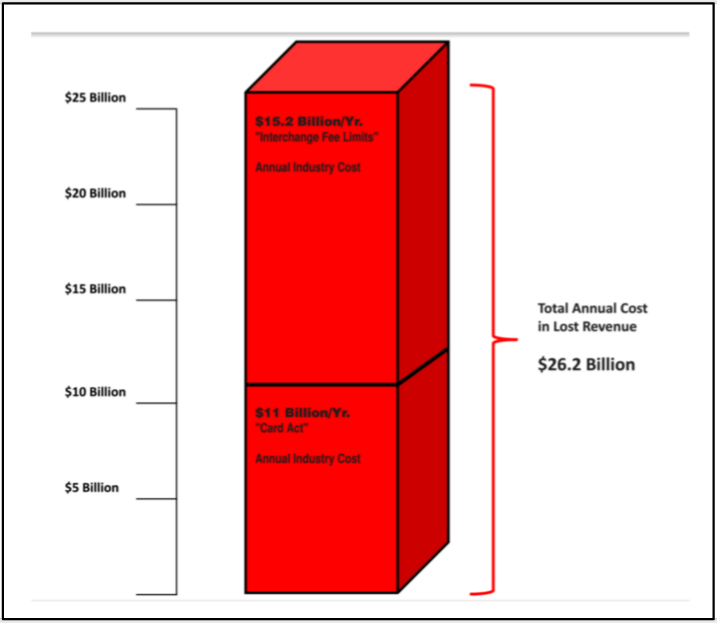
Four years ago we undertook a payment business analysis study of what the possible costs of new regulation and legislation might be for Debit card Interchange swipe fees (2011 Durbin Amendment to Dodd-Frank) and the 2009 CARD Act.

As the chart below shows, our estimate at the time was $26.2 Billion every year in lost revenue for the card industry. That number still seems about right.

Proposed & Actual New Regulatory Cost Impact Per Year

Payment Business Analysis

Total annual cost for banks, as forecast by industry analyst, R. K. Hammer:$26.2 Billion/Year 

Who will pay for all this?  Consumers…in the form of higher fees.

Payment Business Analysis

Don’t get us wrong, we believe that much of what was intended was useful, that card fees needed better more transparent disclosure, what we often coined at the time “The Educational Card Act.”  And in the years since enactment, we still believe much of what was intended produced favorable and important consumer education.

There have also been unintended consequences of these regulations and legislation to the payment business.

Our assertion today is that every action (read, Regulation and Legislation) produces an industry reaction (new and higher fees) to offset the cost of compliance with those new rules and regulations.  It’s just “Economics 101.”  

The jury is still out as to whether or not new card fees will fully offset the annual cost of these regulations – but there already have been and will continue to be new consumer card fees, an financial institutions seek ways to offset the cost of new regulation and legislation.

Some other estimates of new/increased card fees so far are around one-third of what the lost revenue is each year, or $8.6 Billion per year.

That figure will rise in the future since most issuers are going through extensive due diligence on what services are being provide free of charge, and what could be assessed if they chose to do so.

We recognize that some issuers use cards as a cross sell to other important products in their suite of customer services, and therefore may not elect to raise or charge new fees.

Others most certainly will as they treat cards not as a loss-leader but as free-standing profit center.  In fact the card business is often the most profitable product at many organizations, in terms of ROA, ROE, and IRR, if not EBIDTA.

That’s the way I see it.

Robert Hammer is Founder and CEO of R.K. Hammer and Card Knowledge factory ®

M&A Advisory Services

Bank Card Advisory Services

R.K. Hammer is a world-renowned bank card advisory services firm with a payment and credit card industry specialization, our research and that of many others have shown an escalating CPA curve for getting new credit card accounts.  Why is that?

Well, for one the solicitation response rates have plummeted in the last ten years.  Ten years ago we saw an average solicitation response rate of 0.66%, less than one in a hundred, depending on application flow channel.  Today that average number is about 0.22%, a third of what it was a decade before.  You’ve got to send out a lot more offers through all channels just to stay even with your new booked account results of the past.

Next, quality costs.  After the 2008-2010 recession debacle, all card issuers raised new applicant cutoff scores.  The result?  Obviously fewer accounts are approved.  So, as consumers grew cautious, and additionally fewer approvals as issuers raised underwriting standards.  All this raised costs per new booked card accounts.

Then again, new rules and regulations before and after the recession have caused costs to rise, as issuers dealt with compliance issues and loan loss provisions.  The necessary focus on card quality produced additional cautionary measures in most issuers risk management protocols.

Application fraud, as well, has not gone away.  Perhaps not in CPA calculations directly, but it falls to the bottom line just as seriously as loan losses.  If anything, new credit card applicant fraud has become as sophisticated as our own technology and decision science tools.  It is and always been a “cat and mouse” game between the card issuers and the fraudsters.  That is even more expensive to the banks than low solicitation response rates.  Like credit losses, fraud losses come right off the P/L results.

What is the CPA cost to get a qualifying new card account?  Our bank card advisory services research shows that ten years ago it was at $95 on average.  Today that average (of all channels and product types) has risen to $145.  The CPA annual rate of ascent has been at about a 45 degree climb year over year until only recently, topping out.

Bank Card Advisory Services

Can you improve that trend?  Yes, but it takes work.  Pinpoint solicitation target accuracy is the new norm.  Shotgun approaches are out.  Moreover, offers must meet the needs of each particular segment, down to the applicant level.  If a given value proposition bores me or otherwise does not meet my needs, you’ll be in the click delete trash can – real or electronic – in less than 15 seconds.  Lines must be adapted to the present day situation.  An otherwise great product from a world class issuer will fall on deaf ears if the line of credit offered is simply not where it needs to be, in the applicant’s eyes.

What else can be done?  Take a look at your weekly number trends for cardholder sentiment or other customer satisfaction tool data.  Oh, you don’t have that weekly?  There’s an opportunity here.  What do your new applicant focus groups tell you?  Oh, you don’t have those either?  I see a problem that ought to be addressed.

Looking at all distribution channels for new card accounts, the “range” of CPA the last time we looked was between $20 to over $300, based upon channel.  How does that compare to your CPA data results?

You would not expect that a branch sourced application (with other products they also buy from you) to have the same CPA as a customer with whom you have no existing relationship.  In addition the CPA for agent bank applications, merchant take-one’s, online applications, and portfolio acquisitions will be vastly different from one another.

An agent bank program reward for new accounts is often $40 – $50 in the first year per active account, plus an ongoing rev-share of so many basis points on net cardholder sales (50 bps to 100 bps).  On the other hand, a card portfolio acquisition with existing seasoned balances and acceptable credit quality would be worth much more in terms of purchase CPA.  Most of us have a blended population of new accounts from lots of different channels.  The average of all might be $145 but the range by channel will be very wide.

Our recent research at Card Knowledge Factory® shows that the prior escalating trend in CPA for new card accounts is leveling off as it nears its theoretical maximum threshold.  We do not expect that past 45 degree annual ascent rate to continue, but nevertheless will still remain stubbornly high near its present level for the foreseeable future.

There is another meaningful metric to consider:  Net Present Value of those newly acquired card accounts.  How does the present rate for CPA ($145) compare to the Net Present Value of those new card accounts?  How does $1,275 average NPV sound?  That is the latest bank card advisory services calculation at our Card Knowledge Factory® research and analysis division. Therefore, there is a lot of room in the card pricing spread we’ve found for issuers to pay higher rewards for obtaining new accounts.  Take your own data and measure the spread between your CPA and your NPV.  I suspect that your results may be similar.

For more details please visit our Services Page

Credit Card Investment Banking

Credit card investment banking consultant Robert Hammer is an internationally known card expert with decades of industry experience, whose work has been cited in major global financial, banking, and credit union journals.  What “Red Flags” does R.K. Hammer look for in credit card investments?

You watch the card issuer’s reporting, financial statements, regulatory filings, listen to all the quarterly conference calls, and annual reports.  You’re getting the full picture about early warning Red Flag risks, right? Hardly.  More like looking at a space satellite photo view of an exploding Pacific Rim volcano.

It is a well-accepted maxim in the credit card investment banking business that “A loan loss taken early is most always lower than if delayed (for any reason) until later.”  Exactly how does one identify those early warning Red Flags, earlier in the life cycle process, especially since so many of them are not found in financial statements or regulatory filings?

Credit Card Investment Banking Metrics

Risk One:  watch Cash Advance use as a percentage of the total booked loans in the card portfolio.

These non-purchase draws against the card credit line are higher risk, pure and simple.  That is why so many issuers charge a much higher APR for those loans; instead of the normal 14% APR for purchases, some rates for cash use go as high as 29.9%.  It would take decades to pay off if using the minimum payment only each month.  If that isn’t demonstrating high risk I don’t know what is.  What is too much cash advance from a card portfolio risk profile perspective?

See below, the “Percentage of cash advances in a portfolio” in the R.K. Hammer model with green indicating “low risk” up to red being “high risk”.  

If management never discusses these, ask them yourself. As with any metric, it is the trend line not the point in time that matters most.  Of course we want to balance risk and reward; it is simply that at some point that ratio may turn against you.  Examiners and card issuers and cardholders beware.

Risk Two:  Certain Changes in Card Policies

Are all card policy changes bad?  In a word, no.

The ones we are concerned about are those which could be used to conceal or mask true risk, or that delay the loan loss recognition protocol.  Examples:  any change which loosens controls, regardless of management’s rationale; reage policy, where a shorter number of delinquent cycles are used to define when a delinquent account has paid as agreed to classify it back now as “current/non-delinquent” (taking 3 cycles of paying as agreed as the benchmark down to only 2, for example; or 2 cycles down to only 1); delaying charge offs from bankruptcy notification; practices which do not match policies; reducing the new applicant cutoff score.  Also any policy change just prior to a card portfolio sale may be suspect.  “Trust but verify”, as Ronnie Reagan said.

There are bank card issuers who no longer exist today who had done much of the above.  If you don’t see any of this discussed in any report or conference call, ask them for yourself.  You won’t see these on any CD121 FDR/FDC system report, so ask.

Risk Three:  Frequent card member address changes, Returned NSF payments, and First Payment Default (FPD) – the “Big Cahuna.”

Bells and whistles ought to be going off.  Take the loss early, and it will be less than allowing it to roll through the delinquency queues to charge off.  Find out what the figures are, especially FPD, by asking management.  I have never seen this in any report or discussed in any conference call.  Ask, especially about First Payment Defaults (FPD), as most of them are destined for charge off.  Take your losses early.  Close the account.

Risk Four:  High Gross Card Member Attrition Rates.

A gross amount of 10 – 12% of the file may attrite each year; say, 4% for charge offs, and another 6-8% of card members voluntarily leaving/closing their account.  So, you’ve got to book at least another 10-12% of high quality new accounts just to stay even Y/Y.  What are some of the Red Flags?  If the gross attrition rate climbs to higher than 12%, danger ahead.  You may need to re-examine your value proposition.  Customers paying down much greater than the typical 19-20% average monthly repayment rate, calls to customer service inquiring about the full payoff amount, and active card member suddenly becoming inactive.  In credit card investment banking management needs anti-attrition strategies for each of these events.  Ask yourself what those strategies are and the results of their execution, and keep asking until you get an answer you can believe.

Risk Five:  High Credit Line Utilization Rates.

It not uncommon for an average card portfolio to have a 40-45% utilization rate. Higher than that, and our antennae go way up.  Line usage by FICO bandwidth can reflect very wide rates.  Higher risk accounts (and higher risk portfolios) tend to have far higher line usage.  The portfolio yield looks very nice before the high risk accounts start rolling through to charge off at 120 – 150 DPD (“Days Past Due”); by then it’s way too late to correct.  Plus, watch the rate of climb in any attrition or delinquency metric.

Risk Six:  Watch the “30-day delinquency bucket” trend for changes, that’s the “leading indicator.”

The trends of “cure rates” and subsequent roll rates in the delinquency queues can be very revealing.  Watch for changes to the trends early in the cycles.  Make sure the credit card investment banking management exposes that to the light of day, including to you.  Total delinquency by accounts and balances doesn’t give you the early warning risk profile you need to fully judge card portfolio quality.  Watch that first bucket trend.  “Total” delinquency in a portfolio doesn’t give you the total picture, and and may mask (unintentionally, or intentionally) the risks in your portfolio.

Risk Seven:  Other Things to Verify

Repeated requests for line increases, frequent and wide loan balance swings, high unemployment regions, multiple card applications or inquiries being reported, frequent “open-to-buy” requests.  Investors and others may not have the granularity in existing reports to find all of the above, but one should ensure that management does have each of those addressed and monitored.  How they do the monitoring is what I would want to ask about and see for myself.  I don’t think you won’t find these on any FDR/FDC CMO51 system report, either.

There are many Red Flags that do not appear on any system report be it TSYS or FDR/FDC, perhaps not even on monthly Board reports.  Much of it is rarely discussed outside the Risk Committee, Policy Committee or Managing Committee; as an outside interested party or investor you’ve got to ask for the metrics and see for yourself.  “Trust but verify” is pretty sage advice!

For more details please visit our Services Page